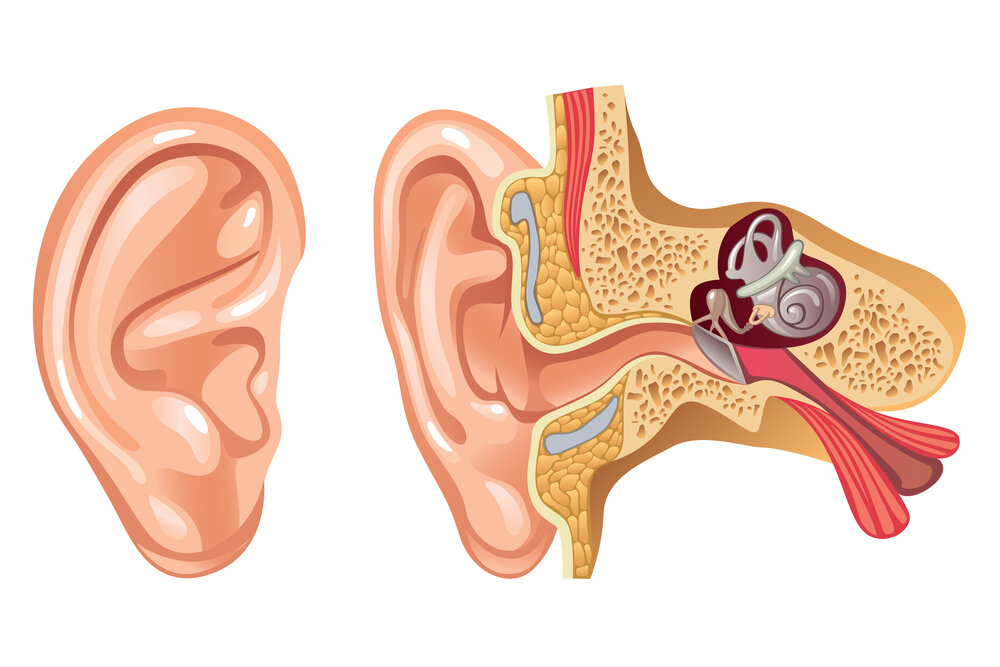
The human ear is the organ responsible for hearing and maintaining balance. It is a complex structure that consists of three main parts: the outer ear, middle ear, and inner ear.
Outer Ear:
Pinna: The visible part of the ear on the outside of the head. It collects sound waves from the environment and directs them into the ear canal.
Ear Canal: A tube-like structure that leads from the pinna to the middle ear. It carries sound waves to the eardrum.
Middle Ear:
Eardrum (Tympanic Membrane): A thin, cone-shaped membrane that separates the outer ear from the middle ear. When sound waves reach the eardrum, it vibrates.
Ossicles: Three small bones called the hammer (malleus), anvil (incus), and stirrup (stapes) are located in the middle ear. They transmit and amplify the vibrations from the eardrum to the inner ear.
Eustachian Tube: A narrow passage that connects the middle ear to the back of the throat. It helps equalize pressure between the middle ear and the outside environment.
Inner Ear:
Cochlea: A spiral-shaped, fluid-filled structure in the inner ear. It contains tiny hair cells that convert sound vibrations into electrical signals that can be interpreted by the brain.
Vestibular System: This part of the inner ear is responsible for maintaining balance and detecting head position and movement. It consists of three semicircular canals and the otolith organs.
The electrical signals generated by the hair cells in the cochlea are transmitted to the brain through the auditory nerve. The brain then interprets these signals as sound, allowing us to perceive and understand the auditory information from our environment.

 science